
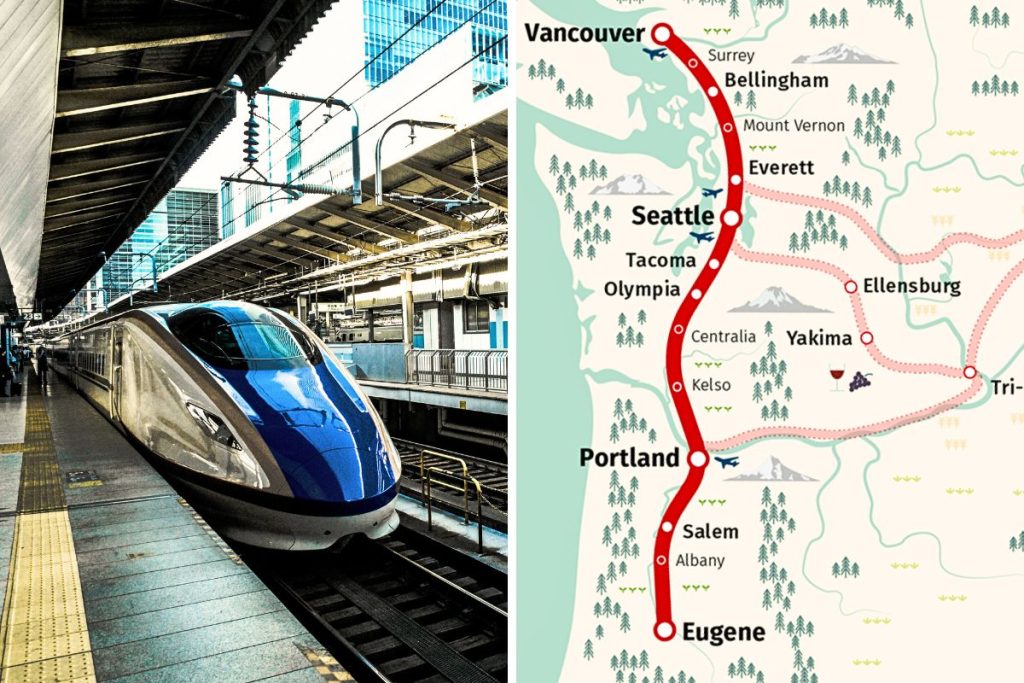
West Coast Canadians and Americans are now a bit closer to high-speed rail travel between the two countries.
A group of Oregon lawmakers announced on this week their support for the progression of the Cascadia High-Speed Rail project, which will connect Vancouver, Seattle, and Portland. They have allocated $49.7 million in federal funding to the project’s planning stage.
RELATED: BC Moves Forward With the $4.15B 8-Lane Massey Tunnel Replacement
[video-ad]
First announced in 2020, the rail would allow Vancouverites to travel to Seattle in just an hour. This is three times faster than car trips or flights (including terminal time).
The Cascadia High-Speed Rail project aims to connect the Pacific Northwest’s major population centers, including Vancouver, B.C., Seattle, and Portland, with trains capable of reaching speeds of up to 250 mph.

The I-5 corridor, a key transportation route in Western Washington, is heavily congested, with Seattle ranked as the second most congested city in the nation.
This federal funding supports critical planning, community engagement, and design work to create an efficient passenger rail route, providing an alternative to highway travel. Serving a rapidly growing population of over 10 million in the Cascadia corridor, the project is expected to transform regional travel by offering faster, more accessible connections between cities.
[content-ad]
Updates so far
In 2022, both Democratic and Republican Washington State legislators approved $150 million USD in funding for a train that would travel 250 miles per hour from Vancouver to Portland.
Additionally, in 2023, the US President’s administration allocated over $8.2 billion USD (C$11.2 billion) to enhance passenger train services across the country, including support for planning the proposed Cascadia High-Speed Rail, which aims to link Portland, Seattle, and Vancouver.
The project, led by the Washington State Government with the support of British Columbia and Oregon, will continue to seek funding to move forward. While the current funding isn’t enough to build the train, it enables them to proceed with advanced planning.
The total estimated cost of the rail, which includes planning, engineering, and construction, ranges from C$32 billion to C$57 billion, with a targeted completion date of 2035.
You might also like

[content-ad]
