
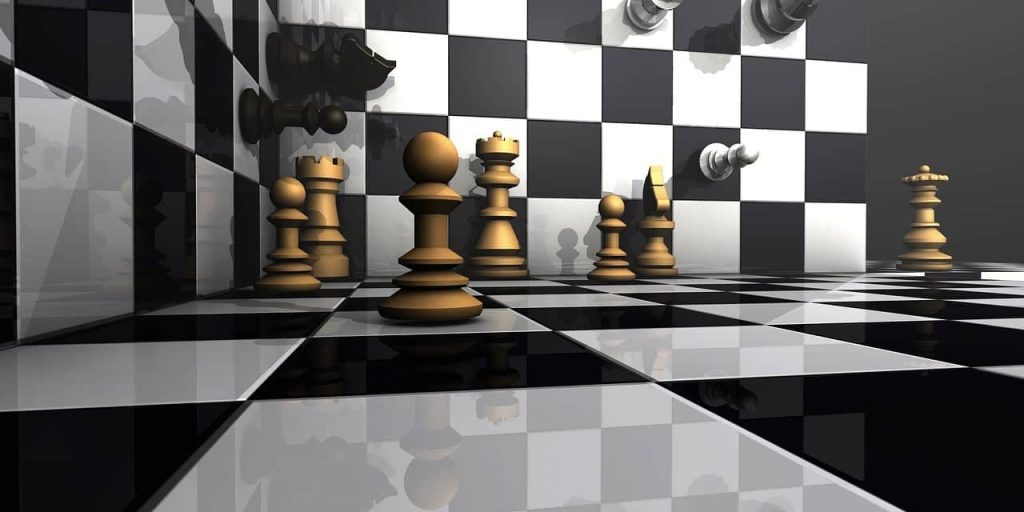
It is often said that the goal of a game is to have fun. But when most people are honest they can admit that the true joy of playing comes from triumph. It is certainly fun to play with friends. But the feeling is all the sweeter for the winners. That goes double for highly competitive games like chess and poker. Winning is especially important to high-stake poker players who have money riding on the outcome of the game.
Chess, Poker and Game Theory
Chess and poker players have been studying these games for centuries, and finding new and exciting ways to improve on them. The recent surge of online casinos has especially shone a light on the popularity of poker among the general public. People are flocking to online casino pages in the hopes of testing their own luck against like-minded players from all over the world. But there are those who would argue that poker is not just a game of luck.
That is where the application of game theory comes in. Crafting strategic models designed around decision-making and maximizing potential for success is as old as the human race. Even our hunter-gatherer ancestors were finding new and innovative ways to succeed in the dangerous world that they inhabited. But in the relatively safe world that we’ve created today, game theory can be applied to any walk of life. The name itself suggests that the entire concept was created with games in mind.
But can we use poker or chess to understand game theory? And just what are the similarities that make it possible for us to equate the timeless board game to the staple of gambling dens? These are both fascinating questions that we aim to tackle in this article. Fans of either or both games may even learn something new about the relationship between them.
Game Theory in Poker
It isn’t easy to explain game theory in detail. But if we were to simplify it we would say that the concept revolves around creating strategies that are meant to optimize results. But how would game theory work in a luck-based game like poker? We already mentioned before that the idea that poker is a game based purely on chance is flawed. The card game actually requires complex strategizing and pre-planning that would greatly benefit from the implementation of game theory.
Professional poker players understand the benefit of approaching poker with a tactical mind. That is why so many of them study game theory extensively. It is common for modern players to implement their lessons into a game and quickly get ahead. So many modern poker players now think like economists that even many amateurs have had to adapt to the new era. It has even brought about the new misconception that one must have a deep understanding of economics to actually become good at poker. While understanding of game theory is not strictly necessary, it can certainly help any poker player get ahead of the competition.
The most popular game theory concept that poker players seem to flock to is the idea of the Nash Equilibrium. The Nash Equilibrium is the idea that a player who has optimized their strategy by analyzing their opponent’s approach will always come out ahead. Putting it simply, it does not benefit a player to switch to a different strategy mid-game. Rather it is better to go into the game without a strategy and formulate one through observation. The Nash Equilibrium has helped poker players improve many of their poker-related skills, from bluffing to behavioral analysis.
Game Theory in Chess
The essence of game theory is perhaps best represented by chess. Often seen as the thinking man’s game, chess remains one of the most intellectually stimulating and beloved board games in the world. We live now in an era where art exhibits and entertainment venues are more available to the general public. It is no wonder that so many are getting into chess. Access to the internet has also exposed many to ideas such as game theory, and new and exciting ways have now been found to blend the two together. So let us see how game theory is being implemented in chess.
One of the cornerstones of game theory is the concept of a zero-sum game. This is the idea that resources are finite, and thus the more one person has the less another can have. It is difficult to find a game that encapsulates this concept more than chess. There are only two players competing, which means the success of one equates to the failure of another. Each player must do their best to analyze their opponent and ensure that they will remain in constant and consistent control of the game.
If the zero sum game is the most basic of concepts to come out of game theory, then there must also be some way to utilize that concept on a practical level. The minimax algorithm a decision-making aid that game theorists use to help them come to the right conclusion. It is a very simple algorithm that relies on two basic pillars from which it gets its name. The first pillar is to minimize the gain of the opponent. A chess player ought to make their decisions based on the opposing player’s potential strategies. The second pillar is maximizing one’s own gain. The chess player should make their decisions based on what would benefit them most. Putting them together grants you a pretty good basis for decision-making.
Why Chess and Poker?
Some might be confused as to the connection between chess and poker? Sure poker is closer to other card games like blackjack or even bridge? The truth is that the intricacies and strategic potential of poker rival that of chess. The focus on strategy and planning ahead is just as great in the casino staple as it is in one of the oldest board games in the world. It is why poker maintains a reputation as one of the most difficult, yet most fascinating gambling games in the world.
