
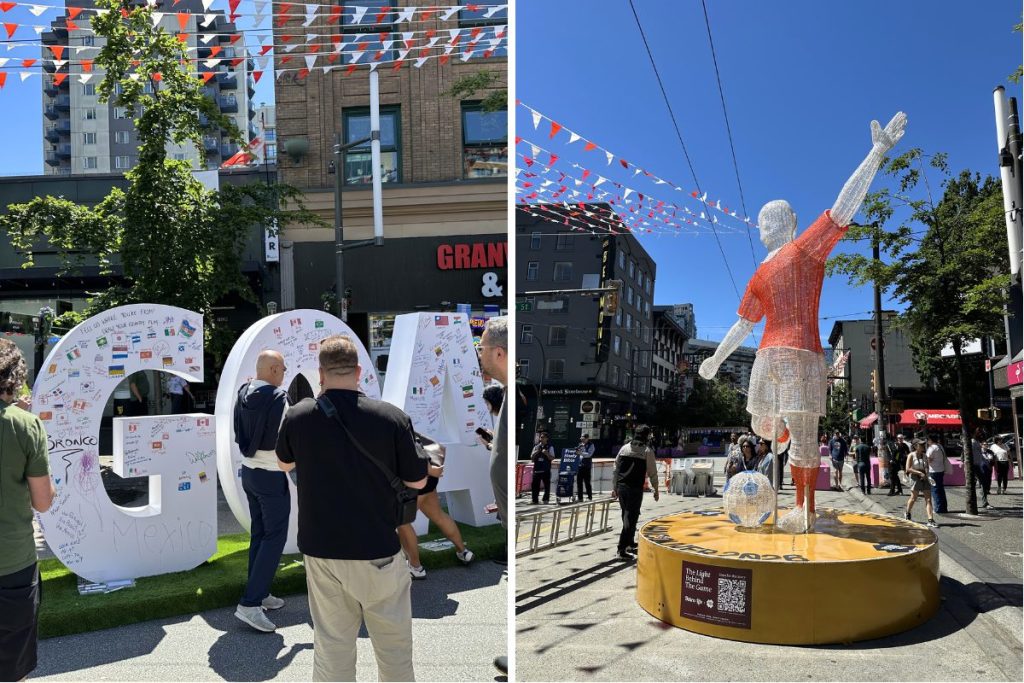
Granville Street’s pedestrian zone isn’t going anywhere this summer. City Council just voted to keep the five-block stretch between Georgia and Davie car-free all the way through Labour Day, well past the end of the FIFA World Cup that started it all.
The vote wasn’t unanimous. Council approved up to $4.75 million to fund the extension, passing 8-2, with councillors Rebecca Bligh and Pete Fry against it. One councillor called the price tag “complete sticker shock.” Fry put it more bluntly, saying the city was “playing fast and loose with how we steward the public purse.”
So, is $5 million a lot to keep a street closed? Kind of. But there’s more going on here than just barricades and cones.
It’s not just a road closure
Anyone can close a street. What Vancouver’s actually done is turn Granville into a proper hangout: patios, games, art installations, greenery, places to sit. That stuff isn’t free, and part of the money, $1.25 million, is going straight to Downtown Van (DVBIA) to keep the programming going all summer.
Closing a street just moves cars out. Activating one gives people a reason to actually show up and stay a while.
Businesses are having a moment
Bars and restaurants on Granville have been posting record sales since the street closed to traffic in early June. That’s a big deal for a strip that’s spent years dealing with pandemic hangovers, empty storefronts and a rough reputation. Instead of being a strictly nightlife street, Granville’s been pulling in tourists and daytime crowds too.
So where does the $4.75 million actually go?
Here’s the real breakdown. Weekly costs run about $300,000 for engineering (sanitation, traffic management, washrooms) plus another $200,000 a week for policing. Stretch that over seven weeks and you’re already at roughly $3.5 million, before adding the $1.25 million going to Downtown Van for programming.
Running a big public space downtown isn’t cheap, especially not on Granville specifically, for reasons that go beyond typical street-closure logistics.
The SRO factor, and why City Hall’s been fighting to fix it
Here’s something that doesn’t get talked about enough: Granville Street has the second-highest concentration of SROs in the city, after the Downtown Eastside. Eight SRO buildings, around 600 rooms total, sit right on the strip. Three in particular, the Luugat, St. Helen’s and the Granville Villa, have been at the center of years of complaints.
The numbers are staggering. Police were called to the Luugat 649 times in 2024 alone, almost twice a day. Officers have responded there close to 4,000 times since 2020. Across all three buildings, police and fire crews made 6,641 combined visits over five years, an 822 percent jump.
Mayor Ken Sim and ABC councillors have been pushing to get these three buildings out of the entertainment district for years, with Sim saying flatly that “supportive housing does not belong in the Granville Entertainment District.” That push actually went somewhere: in March, Sim and B.C.’s housing minister signed a deal to close all three buildings and replace them with 280 new units elsewhere in the city, so residents aren’t just being pushed out with nowhere to go.
It’s basically down to the wire. The Luugat was supposed to close by June 30, and as of this month, three residents were still there past the deadline. So the same summer Granville gets its pedestrian zone is also the summer this years-long fight is finally wrapping up, which is part of why running this street safely costs what it costs.
What’s next
Council’s already thinking past this summer. Staff have been asked to look into bringing the pedestrian zone back in November for a possible Christmas market, and one councillor wants a full cost estimate for making this a three-year thing.
The real test comes after Labour Day
By September, the city should have real data: foot traffic, sales, safety incidents, transit impacts, public feedback. Early signs are good. The bigger question is whether Vancouver can keep that energy going without a World Cup in town, and whether treating a street like a destination, instead of just a route through downtown, is actually worth the price tag.
