
Vancouver voters delivered two significant messages in last weeks municipal election. They elected a new mayor and a largely progressive city council, while also voting overwhelmingly in favour of stronger restrictions on public hard drug use and expanded secure treatment facilities.
The results of Vancouver’s 2026 public safety plebiscite, released on October 21, raise an important question for incoming Mayor Pete Fry and his council: how should the city’s new leadership respond to public support for proposals championed by the administration voters just removed from office?
After all, voting for a different mayor does not necessarily mean rejecting every policy of the previous administration.
Nearly 68% backed both public safety proposals
According to the City of Vancouver’s official election results, both plebiscite questions received substantial support from voters.
The first asked whether Vancouver should strengthen its laws to prohibit the open-air use of hard drugs, including heroin, methamphetamine, fentanyl and crack cocaine, in public spaces. It received 137,178 Yes votes compared with 62,880 No votes, representing 68.6% support among those who answered the question.
The second asked whether Vancouver should formally request that the Province of British Columbia establish a secure medical facility at the former St. Paul’s Hospital or a comparable site. The proposal included acute voluntary care and more than 100 involuntary care beds for people posing serious risks to themselves or others because of severe substance use and mental health disorders.
That question received 135,509 Yes votes and 63,722 No votes, or approximately 68% support.
Although the plebiscite was non-binding, the scale of support provides a significant piece of information for the incoming council. More than two-thirds of respondents supported both proposals, despite the political change taking place at City Hall.
The results go well beyond Ken Sim’s supporters
Perhaps the most interesting aspect of the plebiscite is how its results compare with the mayoral election.
Green Party candidate Pete Fry defeated incumbent Mayor Ken Sim with 98,748 votes compared with Sim’s 67,598. Meanwhile, ABC Vancouver lost its council majority, with just one of its candidates, Mike Klassen, elected to the new council.
Yet 137,178 people supported stronger restrictions on public drug use, more than double the number who voted for Sim.
Even if every person who voted for Sim also supported that plebiscite question, at least 69,580 Yes votes would still have come from people who did not vote for him. The same calculation applies to the secure treatment facility question, where at least 67,911 Yes votes would have come from outside Sim’s mayoral vote total.
These numbers do not reveal exactly how Green, COPE, OneCity or other voters marked their plebiscite ballots. However, they establish that support for the proposals extended beyond Sim’s electoral base. Voters can support a mayoral candidate’s positions on housing, affordability, taxation or political leadership while holding different views on public safety and addiction policy.
Municipal elections involve many issues, and the results suggest that Vancouver’s political preferences cannot be reduced to a single ideological dividing line.
Pete Fry has questioned the value of the plebiscite
The plebiscite itself was controversial before voters went to the polls. The Greens, COPE and OneCity criticized the decision to add the questions to the election ballot, questioning their necessity and arguing that existing laws, provincial responsibilities and alternative health interventions deserved greater attention.
Fry was among those critics. In a CityNews interview conducted before the results were released, Fry described the plebiscite as an election gimmick and emphasized its non-binding nature. However, Fry has also acknowledged public concerns about open drug use and has advocated approaches that would direct people toward supervised consumption facilities, shelter and other health services.
His position highlights an important distinction between recognizing a problem and agreeing on a particular solution.
For critics, the plebiscite’s wording and lack of detailed implementation plans raised legitimate questions about what a Yes vote would ultimately mean. Support for a secure treatment facility, for example, does not necessarily represent blanket approval of every possible form of involuntary treatment.
Similarly, strengthening restrictions on public drug use requires consideration of existing laws, enforcement powers and where people experiencing addiction can safely access health services.
Nevertheless, the results offer the incoming council evidence of public support for the specific proposals voters were asked to consider.
Could the former St. Paul’s Hospital offer an interim solution?
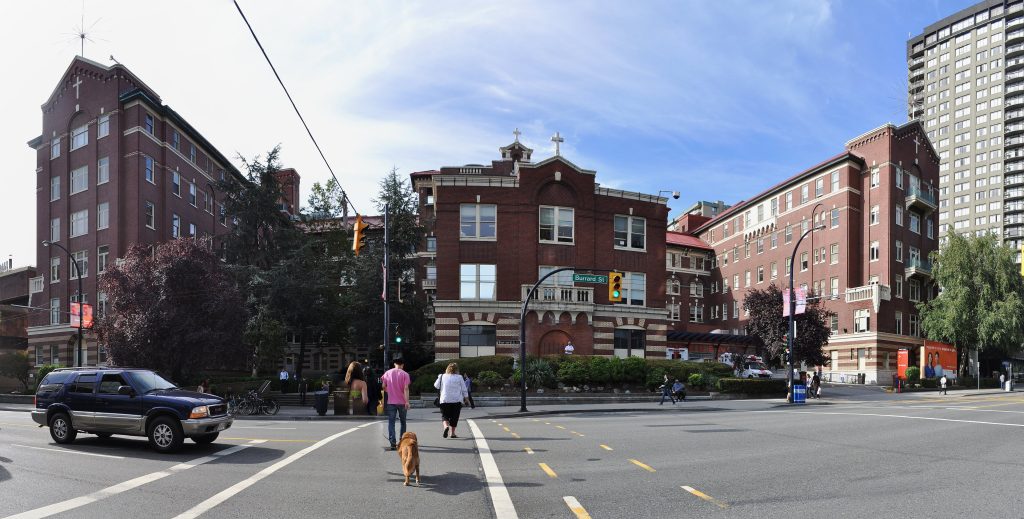
One of the more practical questions surrounding the plebiscite is whether Vancouver could use the existing St. Paul’s Hospital as a temporary treatment facility while permanent infrastructure is planned, approved and constructed. The new St. Paul’s Hospital in the False Creek Flats is scheduled to open in 2027, creating an opportunity to examine whether portions of the existing Burrard Street hospital could continue providing health services.
The 6.6-acre property was purchased by developer Concord Pacific in 2020 for eventual redevelopment. However, that redevelopment could still be years away, with a timeline potentially extending close to a decade.
Concord Pacific has indicated a willingness to discuss temporary uses with governments, although Providence Health Care has extended its lease and some research operations may remain on site until 2029.
The prospect of reusing an existing hospital raises a practical consideration. Purpose-built treatment facilities require land, planning, financing, regulatory approvals and construction. Depending on their scale and complexity, developing new facilities could take five to ten years, although no such timeline has been confirmed for the proposal in Vancouver.
An interim location could potentially provide capacity while those longer-term decisions are made. The Province has already demonstrated a willingness to repurpose existing buildings. In July 2026, it announced 132 additional involuntary care beds through renovations and redevelopment of facilities in Surrey and Prince George, with openings scheduled between late 2027 and 2028.
That approach provides a relevant example. There is also no guarantee that an interim treatment facility would significantly reduce street disorder by itself. Its effectiveness would depend on who could receive care, how patients were supported and what happened after discharge.
Still, the gap between identifying a long-term need and delivering permanent infrastructure is an important part of the public policy discussion. Vancouver’s existing challenges will continue during that period, regardless of how future facilities are financed or constructed.
A new council with different priorities
The composition of Vancouver’s incoming city council reflects a substantial political shift. Alongside Fry, voters elected four Green councillors, four COPE councillors, one OneCity councillor and one ABC Vancouver councillor. The Greens and COPE, in particular, made significant gains compared with the outgoing council.
These parties have emphasized harm reduction, prevention, housing, mental health services and alternatives to criminalization as important elements of Vancouver’s response to the toxic drug crisis. Those priorities are not necessarily incompatible with the public’s support for additional treatment capacity or safer shared public spaces.
Vancouver’s challenges also extend beyond any single policy. Residents, businesses, first responders and people experiencing addiction face different consequences of the crisis, making the development of an effective response particularly complex.
In an earlier 604Now examination of the public safety plebiscite, the questions surrounding municipal authority, provincial health responsibilities and patient protections were identified as central considerations.
The results now give the new council an opportunity to explain how its preferred policies would address the concerns reflected in the vote.
What happens to the plebiscite now?
The plebiscite does not automatically create new municipal bylaws or require the provincial government to establish a medical facility. Vancouver can regulate certain activities in public spaces, but health care delivery and involuntary treatment fall primarily under provincial jurisdiction.
Furthermore, the new St. Paul’s Hospital and other provincial facilities already have secure care capacity planned. Fry has pointed to those commitments while questioning whether an additional facility at the former hospital site is necessary.
These developments create several practical questions for the incoming council.
Would Vancouver’s existing bylaws benefit from changes, or would different enforcement and health interventions be more effective? How will the City work with the Province to evaluate treatment capacity, timelines and gaps in care? And what measures will help determine whether conditions in public spaces and outcomes for vulnerable residents are improving?
Answering those questions would provide greater clarity about how the new council intends to approach the issue, even if its preferred policies differ from the proposals advanced by ABC Vancouver.
The distinction between the City’s responsibilities and those of the Province is also important. Municipal leaders can advocate for additional health resources, but the Province ultimately determines much of the treatment infrastructure and clinical framework.
Vancouver’s election delivered more than one message
The 2026 Vancouver election brought a decisive change in political leadership. But the public safety plebiscite demonstrates that the election cannot be viewed as a simple endorsement or rejection of one party’s entire platform.
Nearly 68% of voters who answered the two questions backed stronger restrictions on public hard drug use and a provincial request for expanded secure treatment capacity. At the same time, voters selected a mayor and council whose preferred approaches to the crisis differ in important ways from those of the outgoing administration.
As Fry and his new council prepare to take office on November 2, the question is no longer simply whether voters are concerned about Vancouver’s drug crisis. The election has provided clear evidence of that concern alongside substantial support for two specific proposals.
What remains to be seen is how City Hall will translate those results, its own policy priorities and the responsibilities of the Province into a response that Vancouver residents can evaluate over the next four years.
