Budget 2026 has been released, and it comes with a particular focus on the rising costs Canadians face in their day-to-day lives. Whether that’s rent, transportation, or food, many people know the weight of today’s financial pressures.
RELATED:
- Canadians Can Score Even More Free Experiences + Discounts With New Canada Strong Pass
- How To Claim Up To $1,000 When Airlines Blame Your Delay On Maintenance
But new measures listed in Budget 2026 seek to assuage these issues, particularly through the Canada Groceries Essentials Benefit. According to the federal government, the benefit “could lift hundreds of thousands of people out of poverty in 2027.”
Canada Groceries Essentials Benefit
The Canada Groceries Essentials Benefit was officially implemented in July 2026, replacing the GST/HST credit.
The new benefit “provides quarterly support to more than 12 million individuals and families with low or modest incomes, and is indexed annually to keep pace with the cost of living.”
It was introduced as a way to offset higher food costs, and saw a 25% increase in July 2026 that will stick around for 5 years from 2026 to 2031. Additionally, eligible Canadians saw a 50% one-time top up in June 2026.
What’s New in 2027?
The federal government announced that it intends to enhance the benefit once again with the 2027 Canada Groceries and Essentials Benefit Supplement. This would provide a one-time 50% increase for the 2026-27 benefit year, arriving in early 2027.
For a single person without children, they can receive up to $339. And for a couple with two children, their amount could be up to $679.
Combined with the June 2026 top-up and the 25% increase in the benefit as of July 2026, this supplement would bring total support in 2026-27 to up to about $1,290 for a single person without children and $2,570 for a couple with two children. It would provide $4.1 billion in additional support to Canadians and is expected to lift an additional 120,000 people out of poverty in 2027.
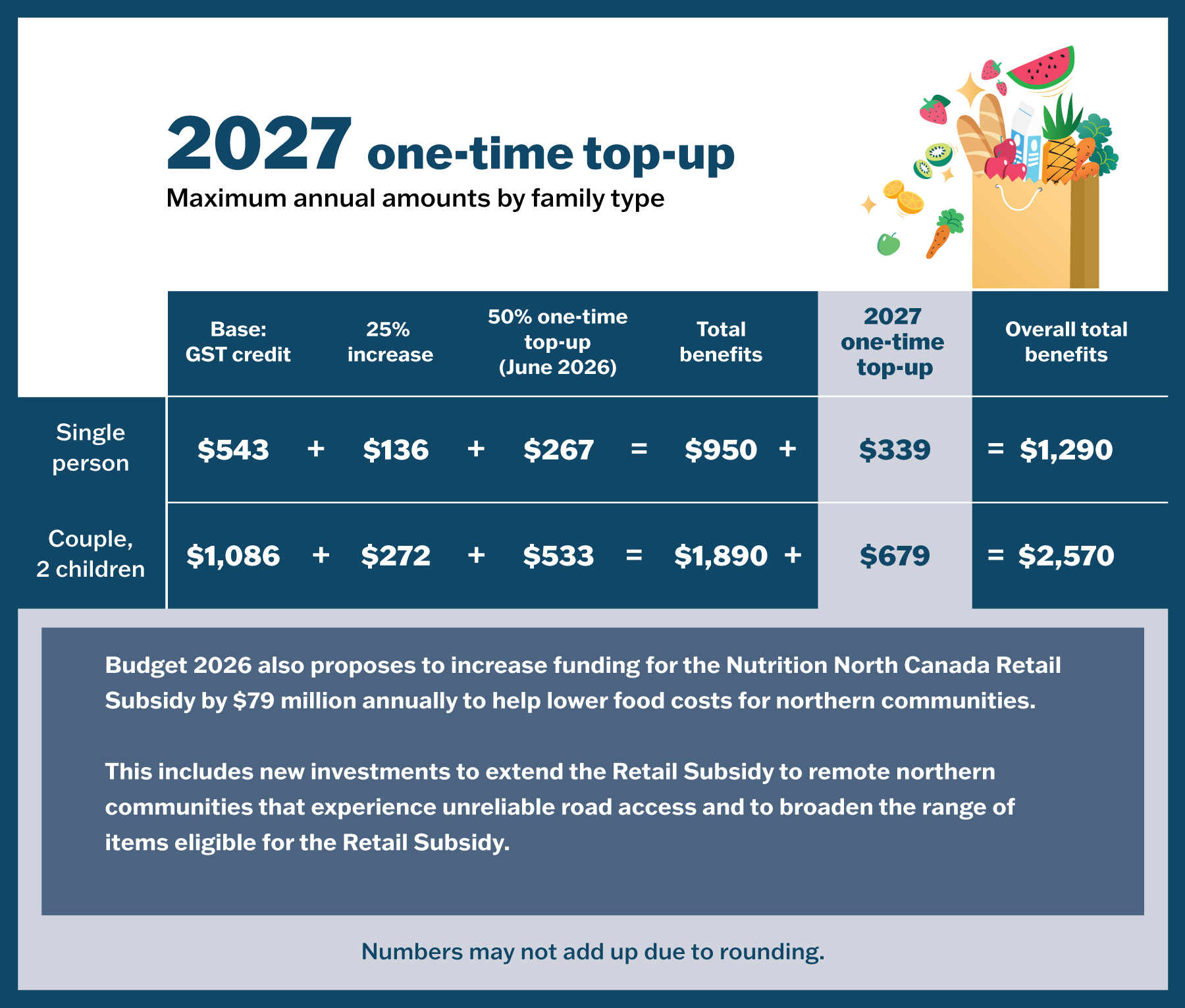
Budget 2026 also plans to expand and stabilise funding for Nutrition North Canada, which seeks to help lower imported food costs and support local food harvesting in remote northern communities.
You might also like